Marinus Willett
It was only fairly recently, when I was conducting some genealogical research, that I came across the figure of Marinus Willett, one of the earliest Sons of Liberty, and something of a Revolutionary War hero. In this year of celebrations for America’s 250, I’ve been showing the kids various stories from that conflict—and what a treasure-house it is, of dashing figures, desperate attempts, soaring rhetoric—and so reading about a few of them myself: some for the first time. Since most people have never heard of him, I thought I’d share a few scenes from his life that I found interesting.
The first point that caught my attention is that, like many boys his age, Marinus fought in the French and Indian War, where he chanced to meet George Washington. He was immediately struck by the latter’s personal gravity and magnetism; biographers recount that from the moment of their meeting, Washington ranked second only to the Almighty in the boy’s estimation. I knew that GW commanded a great deal of respect later on, especially by the time of the Continental Congress, but I guess I had assumed that had developed from stories, politicking, his reputation after the war, but no: he was apparently not only presidential, but monumental more or less instantly, and even when young, at least according to my ancestor’s impression.
Later, as things were heating up in the colonies, Marinus saw first hand how the British press-gangs abducted men and boys for service in ships and determined right then how undignified was the whole practice. When the Sons of Liberty formed in Boston, Marinus became the founding member of the New York chapter, eager to fight tyranny on behalf of his neighbors.
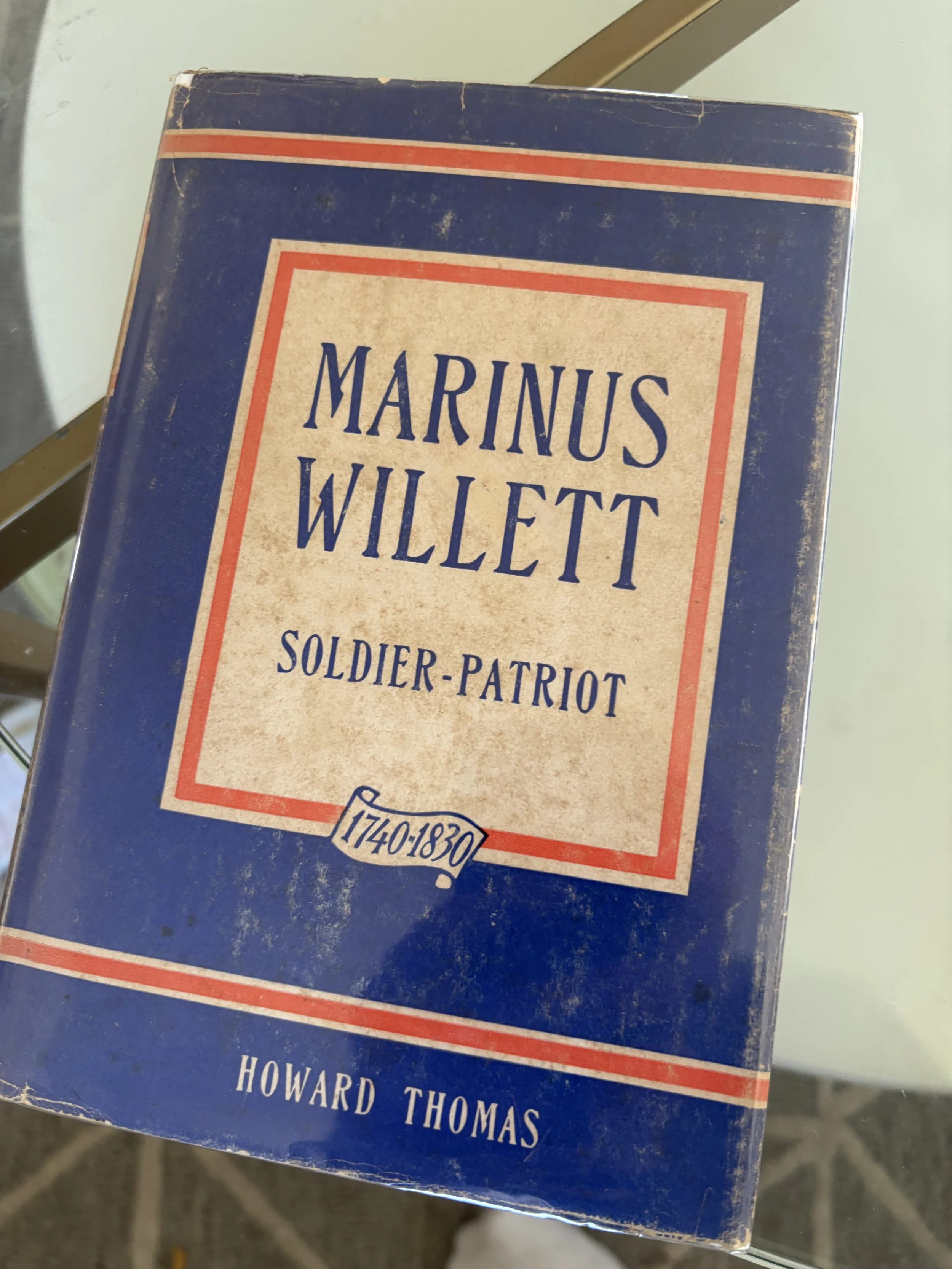
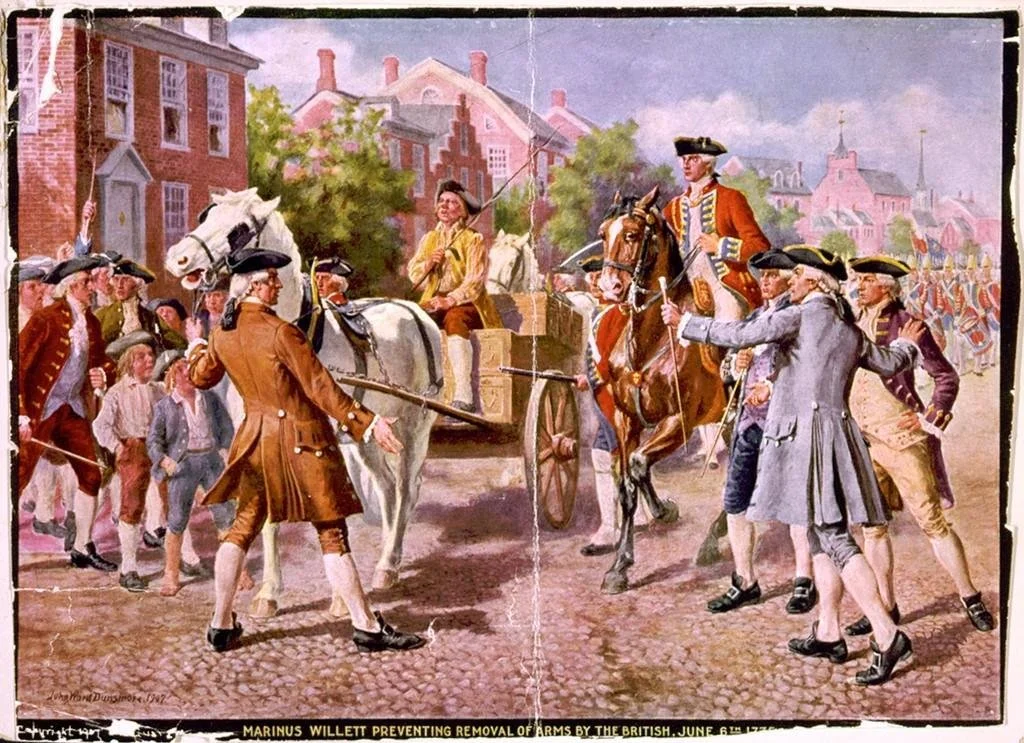
Here’s one of the most famous stories about him. He went to Kings College with Alexander Hamilton with whom he staged demonstrations against the Stamp Act; when the conflicts began in earnest and British Army was given permission to withdraw from Manhattan for Boston, they (naturally) assumed, being, you know, an army, that they could take their weapons and ammunition with them. Marinus apparently disagreed. And here’s the crazy thing about it: he seems to have disagreed alone. There was no vote by the Sons of Liberty, no large-scale protest against their leaving under arms. But Marinus took it upon himself to stand in the street, stopping the train of supplies from leaving New York. Here is the story from Howard Thomas’ account:
Marinus Willett, standing with legs apart in the middle of the intersection, blocked the way. Though he was one man abasing a British detachment, he seized the bridle of the lead horse. The cart drew up short, causing an abrupt halt in the procession. A British major, resplendent in scarlet and gold, rode up. Anger painted his face the same color as his uniform. ‘What is the meaning of this insolence, he asked, placing his hand on his sword.
Marinus explained his positon—they were allowed to leave unmolested, but not to take spare arms. The Mayor was nearby, who told Marinus to stand down “I am surprised that you would hazard the peace and endanger the lives of our citizens [thus]”. But he wouldn’t budge. So they bring over the Governor, who sided with the mayor, but still, he wouldn’t let go of the reins. Someone in the crowd shouted that they should put the question to John Scott who read the form and said something to the effect that technically, they weren’t given explicit permission to leave with arms, so Willett was right.
He jumped aboard the cart, made an appeal to the British soldiers right then and there to switch sides (only one did), and turned the cart of arms around for later use against those same troops by the Patriots. Amazing!
The scene was made into a painting by John Ward Dunsmore.
Willett was later made a Colonel in the Army, in charge mainly of a string of forts protecting the Mohawk Valley, where he won distinction over and over at stealing supplies—everything: blankets, horses, canons—through various clever ruses, and at holding out in various half-build frontier blockades against huge forces of British and crown-aligned Indian attackers. One of his forts flew among the very first American flags ever. The congress issued a statement saying we should have a new one without the Union Jack, but consisting of 13 red and white stripes and 13 stars on a blue field. The day the article was printed, Willett was investing Fort Stanwix. They cut petticoats for the red, and ammunition shirts for the white stripes, but had no idea where to find blue cloth until they remembered a blue Camelot cloak captured from a defeated British officer at Fort Constitution that one of the men had kept as a souvenir. They cut it to pieces and made the field, raising the stars and bars on August 3rd, 1777.
There’s lots of other fun stuff.. Willett became mayor of New York, which is crazy because he took over from a man named Dewitt Clinton, which is the name of my next door neighbor, his direct descendent. Those two neighbors’ progeny became neighbors again 150 years later in Seattle, WA.
Apparently there is a Marinus Willett Center at Fort Stanwix National Park, and you can see his portrait and his sword, a gift from Washington himself, in the Met.
Happy 250, America 🇺🇸