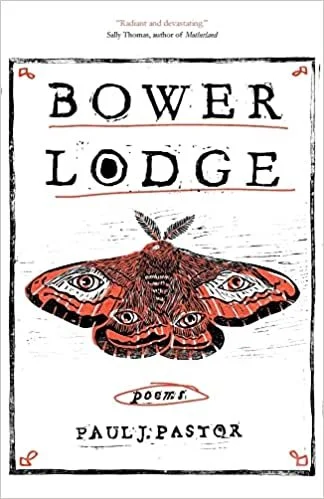
Bower Lodge by Paul J. Pastor
For all its intimations of quietude, there's a wildness in Pastor's poems- think Berryman's dreaming songs or Whitman's barbarian yawp-a rusticity that is as defiant as it is pastoral. This book is a plumage, not of butterfly or bird, but of moth wing, which is to say: a blessing.
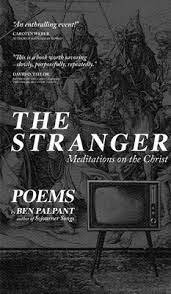
The Stranger by Ben Palpant
Ben Palpant’s poems in The Stranger breakdance through both biblical and literary history, remixing tunes from Tennyson and Gwendolyn Brooks with samples from the pop band Starship and the Divine Office. But those juxtapositions are not this strong collection’s best surprise. Rather, it’s the big quiet after each poem ends in which we mouth both How true and Hallelujah. This book is at once a daring and a tender undertaking.
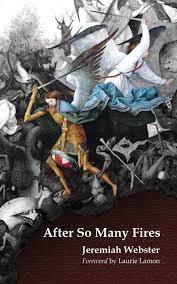
After so Many Fires by Jeremiah Webster
After so much posturing on the parts of pundits, preening celebrities, poets on the picked through street market of the avant-garde; after so much hollow flash, so much essentially genre-bent lineated prose of small epiphanies; after so much, well, else, Jeremiah Webster’s After So Many Fires comes out of the Pacific Northwest like rain: greening everything, cleaning the language, sharpening the eye, casting a slant-lit wonder about this whole good God-haunted earth, and, most importantly, allowing again a kind of deep breathing.
Christian Poetics Initiative with David Mahan
You speak of exploring the “pliability of formal structures in making verse.” Can you elaborate what you mean by this, perhaps again in light of your faith?

Aarik Danielsen for EcoTheo Review
Willett whirs and waxes rhapsodic, yet never writes from disembodied fancy. He converses with what he classifies knowing that, if we’re lucky, our understanding falls within the margin of error.

SPU Stories with Amanda Stubbert
I had never met a professor, never met anyone who had a PhD. I had never called anyone doctor, apart from my doctor.
Ascent Scholars: Faculty Profile
When Mischa Willett started college in the late ‘90s, he encountered an academic environment that was completely unfamiliar to him.

Changes and Chances in Literary Pedagogy
English departments at Christian liberal arts institutions have faced a broadband array of economic and cultural challenges in recent years, but I’m optimistic.
Fading Crimean Flowers
In their refusal to aestheticize Crimean warfare, as most of their fellow poets and newspapermen had done, Sydney Dobell and Alexander Smith, in the co-authored Sonnets on the War (1855) present a harrowing picture of the conflict from myriad viewpoints, all of which deny the patriotism and hawkishness implicit in glamorizing armed conflict.
A Hateful Cawing from the Crows
W. E. Aytoun's satirical verse drama, Firmilian (1854), an anti-radical, scattershot missive meant to re-align British poetic tastes by reversing the aesthetic gains made by Romanticism in the decades prior to its publication, has been called “one of the most successful pieces of literary criticism ever written,”but did Firmilian accomplish its purposes? In what ways can we consider it successful if not?
Shelley's Spasmodic Afterlife
Percy Shelley's political legacy passed through an often-neglected school of writers to world leaders and revolutionaries globally in the decades following his death. When assessing his legacy, we should not overlook those early, ardent appreciators known as "the Spasmodic School." Alexander Smith, Sydney Dobell, J. Stanyan Bigg, and even James Thomson B.V. took Shelley's call to a revolution conducted through imaginative sympathy seriously, and together, helped to fan his "fading coal" to flam
Small Letters and Sparrows
What qualifies as a miracle worth recounting? And how far beyond the probable does an event need to be before we consider it miraculous?
4 Simple Ways to Help Your Most-Disconnected Students
Faculty members have a key role to play in retaining students, to the benefit of both.
Joy of Every Longing Heart
But what if we think about a different shape for Advent, one that builds slowly toward Christmas in a gradual way–she’s pregnant! There’s the star!– that Christmas day is a punctuation, the celebration, all our hopes come true at last, and then Christmastide is the season of reflection there-following?
Violence and Absence
In several poems, William Wordsworth considers the active representation of absence-- a stone circle, a zero, an “O the difference to me!”-- as a response to violence. Absent histories create our own involuntary misreadings, well-rehearsed in New Historicist debates surrounding Tintern Abbey, and Three Years She Grew, but present absences can heighten the descriptive violence as in a Hitchcock film where one only hears the scream as a camera cuts away, or as in Wordsworth’s lesser-known Alice Fell, wherein the violence reeked upon a girl is displaced onto surrounding objects making it at once more palatable and more subversive. This paper’s method is to consider Ovid, Wordsworth’s favorite poet as a young man, as a likely template for this trope. I show that certain of Wordsworth’s poems emerged as exercises in Ovidian imitation, and that he used the erasure of this poetic father to add darkness and suggestion to poems that are often misread as innocent.
Still Life with Wine and Occasional Fires
Normally, though still a frenzy, my writing has built-in speed bumps, to keep the crystal from jittering around.
Humanities Research with Undergraduates
Admissions brochures routinely tout the benefits of small class sizes, with pictures of lab-coated undergraduates doing beaker work alongside science professors in safety goggles. I’ve always wondered: Is the research, like the image, staged or real?
Theatricality and Imaginative Failure in Keats
Keats’ “Ode of a Grecian Urn” may be one of the language’s greatest poems, but it also contains some of poetry’s worst lines. Those lines, especially “More happy love, more happy, happy love,” are not mis-steps; they are failures, and, I’m arguing, active failures in Zizek’s sense, a kind of theatrical dive, meant to claim for the poet a documentable experience of the sublime.
6 Black Protest Poets
In times of increasing racial tensions, it can be difficult to know what to do with one’s anger, righteous or otherwise. And it can be just as difficult to know where to get an honest picture of the worldviews of people we may consider, for whatever combination of reasons, “other.”