I
I hate that line in Good Will Hunting when the counselor (Robin Williams) says to the genius janitor (Matt Damon):
So if I asked you about art, you’d probably give me the skinny on every art book ever written. Michelangelo, you know a lot about him. Life’s work, political aspirations, him and the pope, sexual orientations, the whole works, right? But I’ll bet you can’t tell me what it smells like in the Sistine Chapel.
I hate it not because it seems to me a kind of bullying, like age condescending to youth and inexperience (though that’s true), but because the Sistine Chapel doesn’t have any particular smell. The Domus Aurea, sure: a bit mossy and dank, but cool, and with imaginary lavender. The Palatine smells vaguely of cats and burning wheat. Even Saint Peter’s, just a stone’s throw from Capella Sistina, has a scent: clay, and neoprene rope, and tourists. But the Sistine Chapel hasn’t even an olfactory trace of incense, or oil paints, or sweating sixteenth century architects lying on their backs.
It may have had all those things when, in 1598, another painter named Michelangelo (Merisi da Caravaggio), from a town by whose name he was eventually known, made the first of his many visits there to see the great painting that his namesake had called forth from the abyss. We think of the Sistine ceiling as heavenly and eternal, but it helps to remember it was new once, shocking, and influential in a different sense than we mean it now.
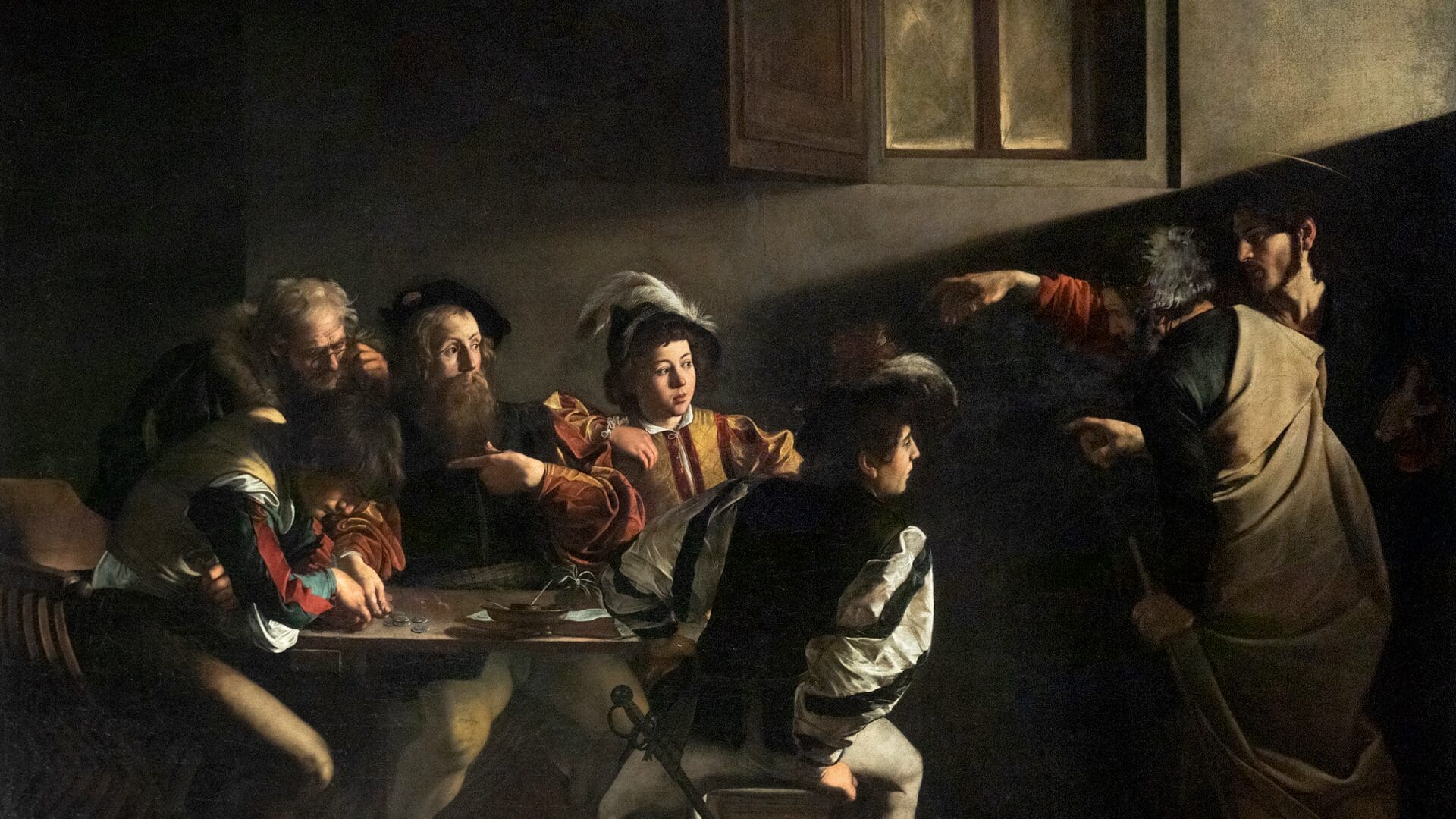
And so, when, not 20 years later, Caravaggio unveiled The Calling of St. Matthew at San Luigi dei Francesi, the resonance would have been immediately clear, and unmistakable. The dramatic centre of the painting is the Christ’s hand, pointing into the crowd, and it’s the same hand, visually speaking, that hangs from the Sistine ceiling. Caravaggio had copied elements of Michelangelo’s thought before—the former’s Conversion of Saul in the chapel of Santa Maria del Popolo for example, features prominently the rear-end of a horse which never appears in the biblical account, but which was featured in Michelangelo’s Vatican fresco of the same scene—but this copy of a gesture is so direct, and so central to both paintings, that the mimicry ought to give pause. What does it mean then, this limp wrist, the Creator’s finger nearly touching Adam’s, and Michelangelo Caravaggio’s appropriation of Michelangelo Buonarotti’s signature piece of painterly theology?
Matthew was a tax collector, and so the scene of his calling in Caravaggio is the interior of a rendering house. Though it appears to be mid-day (with a slant of light so steep, one would only actually see it in the early morning, or in northern climates) the room is all shadows, suggesting bribery, double-dealing, and the general crookedness of the Roman colonial taxation system.
The characters are dressed as renaissance Florentines, a choice which does the work of implying pre-conversion Matthew’s complicity with the Roman domination system. As a Jew, he should have been working toward God’s justice, which was to come to the world through his people; instead, he’s helping an occupying force to exploit them.
Read the full essay at Comment →
Originally published in Comment, 2012-05-04.
Image credit: Image from Comment article page (https://comment.org/wp-content/uploads/2012/05/The-Calling-of-Saint-Matthew.jpg)