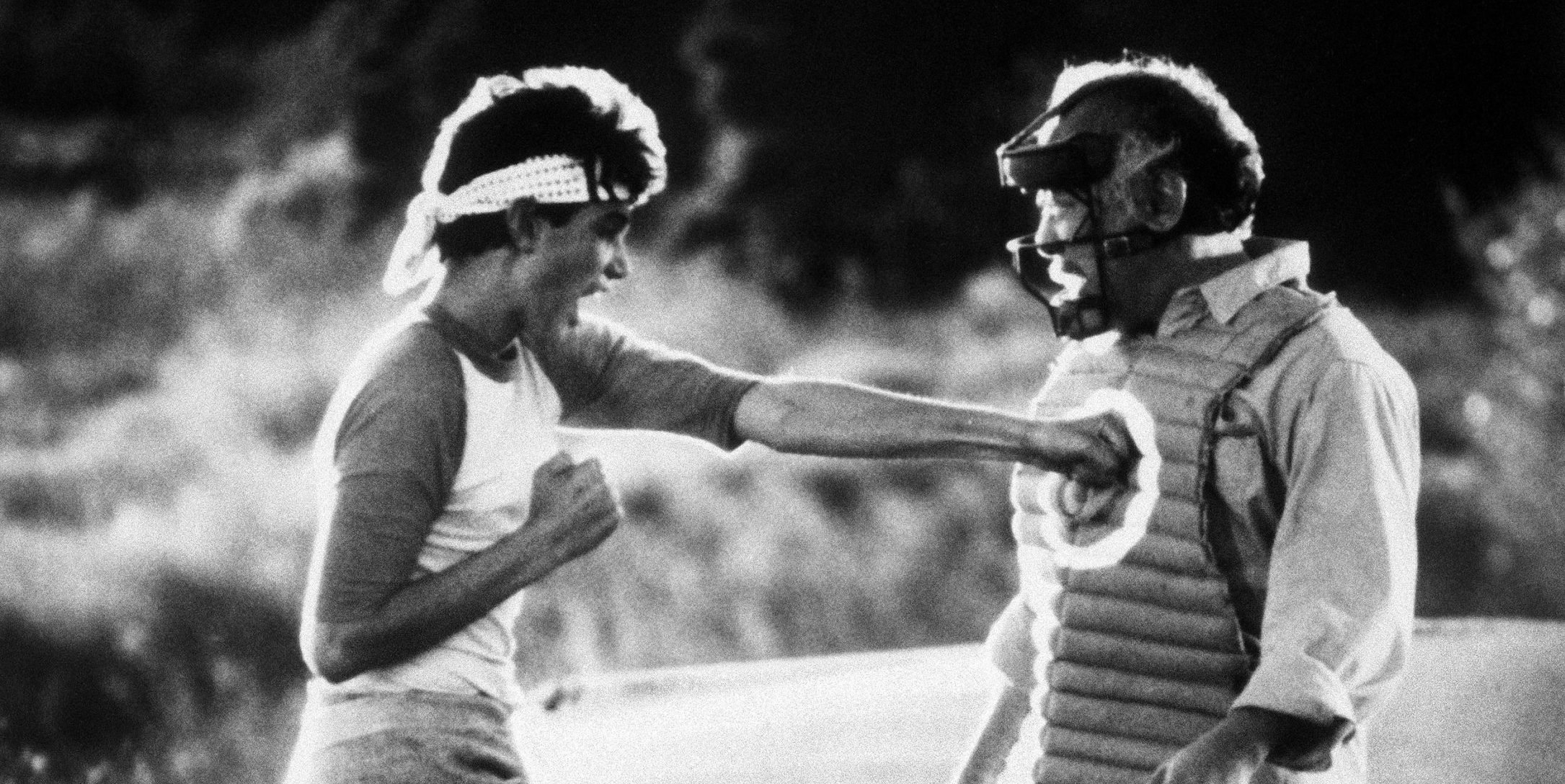
Mr. Miyagi has played it so cool the whole movie long that when we finally see him respond, after the All-Valley Karate Tournament, after Sensei Kreese from the rival Cobra Kai dojo breaks Johnny Lawrence’s trophy and strikes his own students, there’s a feeling the audience has — one that we’re supposed to have — that goes something like ohhh, he’s going to get it now! We’re about to see justice enacted, wrongs set right. It tingles in the belly, the anticipation. As viewers of the film The Karate Kid (1984) will remember, what we actually see is Kreese attack Miyagi, who, just in time, steps smoothly aside causing the Sensei to miss, punching out the windows of a nearby car and rendering the weapons of his hands useless. Finally, we think, oh let justice roll down like a mighty torrent! Like a great rushing of waters! Miyagi raises his hand for a classic karate chop, growling from his dan tien to summon the power that we know can break clean through sheets of solid ice — what might that hand do to a man’s face? — only to stop the flood at the last moment, like some angel disarming a would-be sacrificer on the mountain. Instead of Miyagi annihilating this opponent, he deals out a playful honk of the nose, in a gesture a bit like the Native American practice of counting coup: a nick that says “I could have taken you out and didn’t.”
I’m thinking about The Karate Kid first because I grew up in the 80s, so I’m sort of always thinking about The Karate Kid. Yesterday as I wrote this, my son Sebastian wanted to play wrestling, so I taught him the crane kick. As the saying should probably go, “You can take the kid out of the 80s, but you can’t take the 80s out of the kid.” But more than that, I’m thinking about this scene because I’ve just finished teaching a college course on Shakespeare.
I probably shouldn’t have assigned it. I’ve taught it before and it always goes the same way. But there is so much good in it, so much that’s worth getting and so many conversations worth having, that the Merchant of Venice wandered onto our syllabus again this year, though cautiously. At first, the play goes pretty well; as Shakespeare texts go, it’s one of the easier ones for students to understand. They like imagining quattrocento Venice. They like the fairytale subplot about Portia, whose husband will be chosen via a kind of shell game, and who delivers the lovely “quality of mercy is not strained” speech. They understand Antonio, the merchant who needs to borrow money to achieve his grand dreams and who opens the play with a relatable bit of melancholia:
I know not why I am so sad
It wearies me, you say it wearies you,
But how I caught it, found it, or came by it,
What stuff ’tis made of, whereof it is born
[I know not]
And they’re stirred by Shylock, the Jewish banker, who argues for the universal brotherhood of all people, a plea for sympathy across religious and racial lines that still shocks in its candor.
Hath not a Jew eyes? Hath not a Jew hands, organs, dimensions, senses, affections, passions; fed with the same food, hurt with the same weapons, subject to the same diseases, healed by the same means, warmed and cooled by the same winter and summer as a Christian is?
Read the full essay at Mockingbird →
Originally published in Mockingbird, 2023-11-16.
Image credit: Image from Mockingbird article page (https://mbird.com/wp-content/uploads/2023/11/WILLET-1-scaled-e1699996297399.jpeg)