Steven Searcy for Mere Orthodoxy
“So much poetry fails to achieve (or even attempt) either humor or spiritual depth, but both are hallmarks of Willett’s work”
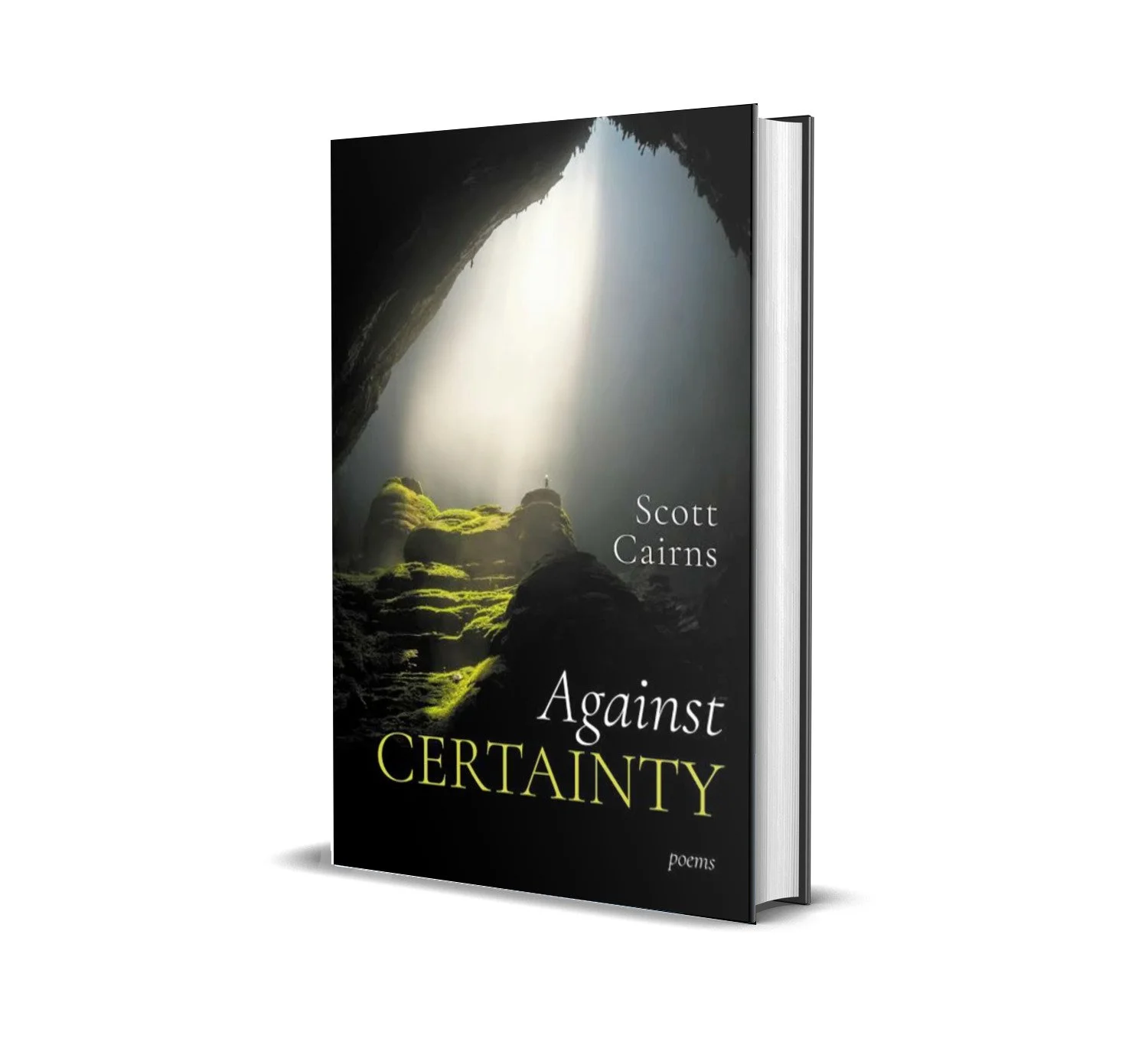
No Foolin’
These are intelligent poems, almost miraculously articulate and informed, and stuffed with references to Cairns’ lifetime of reading.

Buechner on the Rostrum
I’d never heard his speaking voice before and was stunned to hear even his casual, or social, remarks dealt out in the same elegant syntactic registry as his published writing. So, what is Buechner like as a sermonizer?
Old Books with Grace
I went on this fun podcast to talk S.T. Coleridge and creative resurrection.

Galahad and the Grail by Malcom Guite
What treasure has been hauled up from the ancient wells in this outing—the Arthur stories re-Christianized after so much balkanization, a myth for England proffered at an hour of dire need, but also the poetic epic resuscitated as a fit mode for history, for fantasy, for fun. This book teems with a vitality rarely found in contemporary work because it can’t be: its older than that, deeper than the green of upland hills, sweeter than festival-tide communion wine, but also rough, and brave, and strange as a stone circle, and older magic still.
Inkwell Interview on Writing Programs
Three seasoned writers who have given a great deal of thought to training Christian writers are Mischa Willett, director of the Whitworth Writers Workshop, and James Matthew Wilson and Joshua Hren, cofounders of the MFA in creative writing at the University of St. Thomas in Houston.
Group MFA Interview with Nadya Williams
I didn’t know what most of the words meant, nor had I any sense of the majestic realities beneath them, but the cadence lulled me like a song.

Gathers his Inheritance: Buechner on Houses and OZ
Frederick Buechner’s “Entrance to Porlock” is a meditation on the oddness of generosity, and on Coleridge, and flying houses.
Profile in ACU Newspaper
Most schoolchildren countdown the seconds until recess. They look forward to going down the slides and playing games with their friends. However, this was not the case for Mischa Willett, a professor new to ACU this year. In fourth grade, he would skip recess just to read his teacher’s poetry.


Unto Thyself Any Graven Images
William Blake was not only a painter and a poet, but considered himself a prophet of God, and thought every Christian should be one too. His work has attracted critical attention from its earliest days, and his body of poetic work is among the most-considered we have in English.

Jar of Flies
Mostly, these poems are brave and direct meditations on common life, but not in the aestheticized version of the confessionals wherein the poet cuts an onion so lovingly, so specifically, so poetically that we're supposed to go re-enjoy the world in all its quirky wonder thereafter. Rather, they're concerned with the real difficulties of trying to please one's father; of having friends lose touch due to drug abuse, with everything.

Selling Romantic Victorianism
Literary Advertising and the Shaping of British Romanticism helpfully chronicles the rise of advertising in periodicals, highlighting its methods and subjects, from shoe-blacking to tooth powders.

Spellbinding: on Mariner, a Voyage with Samuel Taylor Coleridge
Let’s get one thing straight: there is nothing wrong with shooting an albatross. The albatross was never taken commonly to be a symbol of Christian piety, nor were they “tutelary spirits” of a particular region, as Coleridge’s friend Wordsworth somewhere suggests, and as guides of a voyage they were perfectly useless. To kill one (or several) was not to declare one’s independence of nature, or of a God’s provision, and thus mount up on waxen wings, but was instead an effective way to get fresh meat at sea.

Rediscover Poetic Enchantment with Charles Taylor
In Four Quartets, T. S. Eliot called poetry “a raid on the inarticulate.” I’ve always liked the phrase. It implies the chaotic mess of life in a postlapsarian world is mimicked in language’s fragmentary nature. It also implies poets can do something about it, diving into the deep as they find treasure and nourishment. Having found them, they can offer them for our benefit. There’s something clandestine about the whole operation—a raid—reminiscent of the Promethean theft of fire.

On Shelley and the Apprehension of Life
Poetry is already opaque enough for most readers, and the critic’s role is to offer clarity where possible.

The House on Dravus
A few years back, our landlord decided to sell the house we had been renting, where we raised our kids, and knew and loved all our neighbors. It was devastating. We had to find somewhere in Seattle that we could afford on my professor salary, and quick.